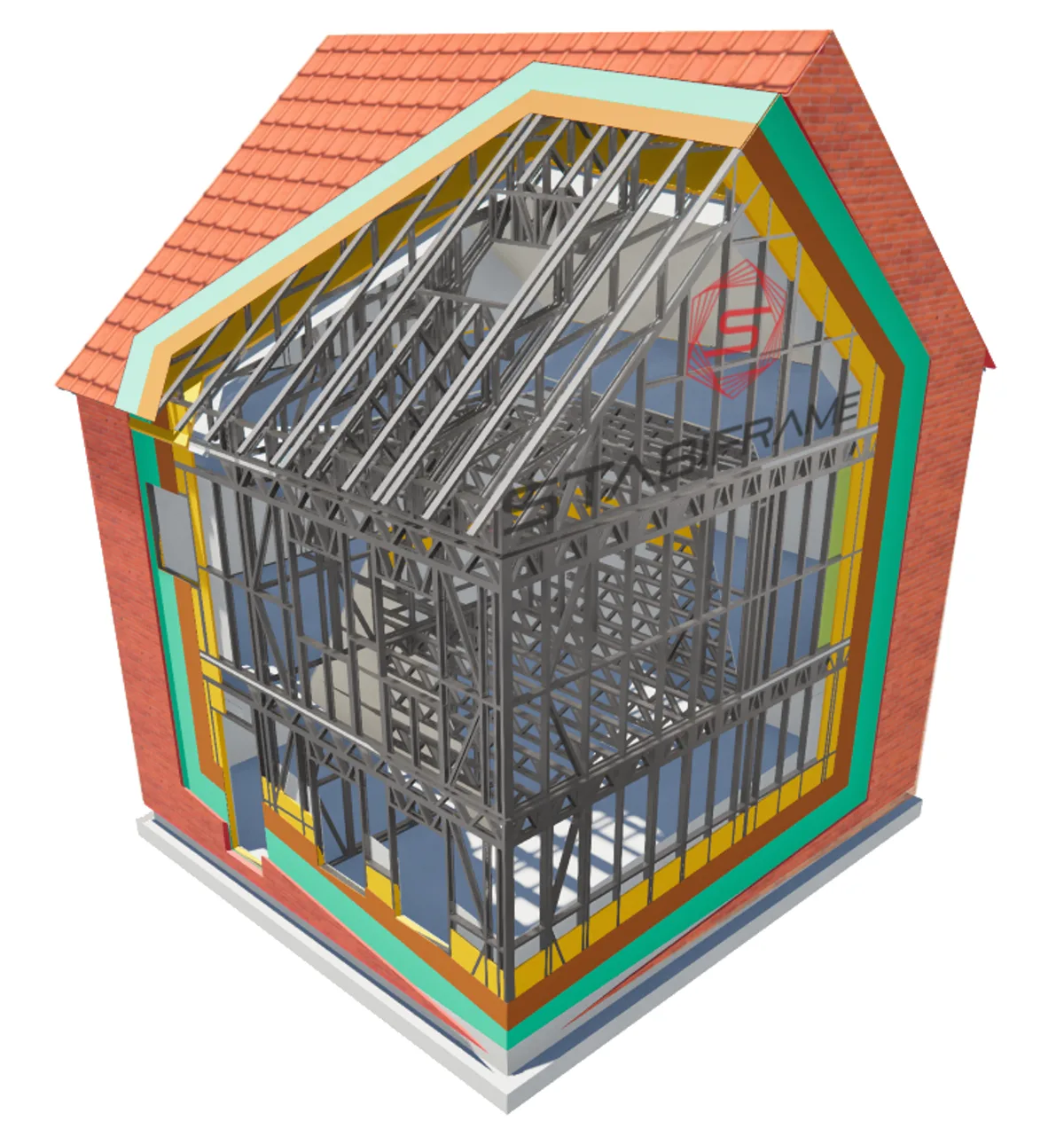
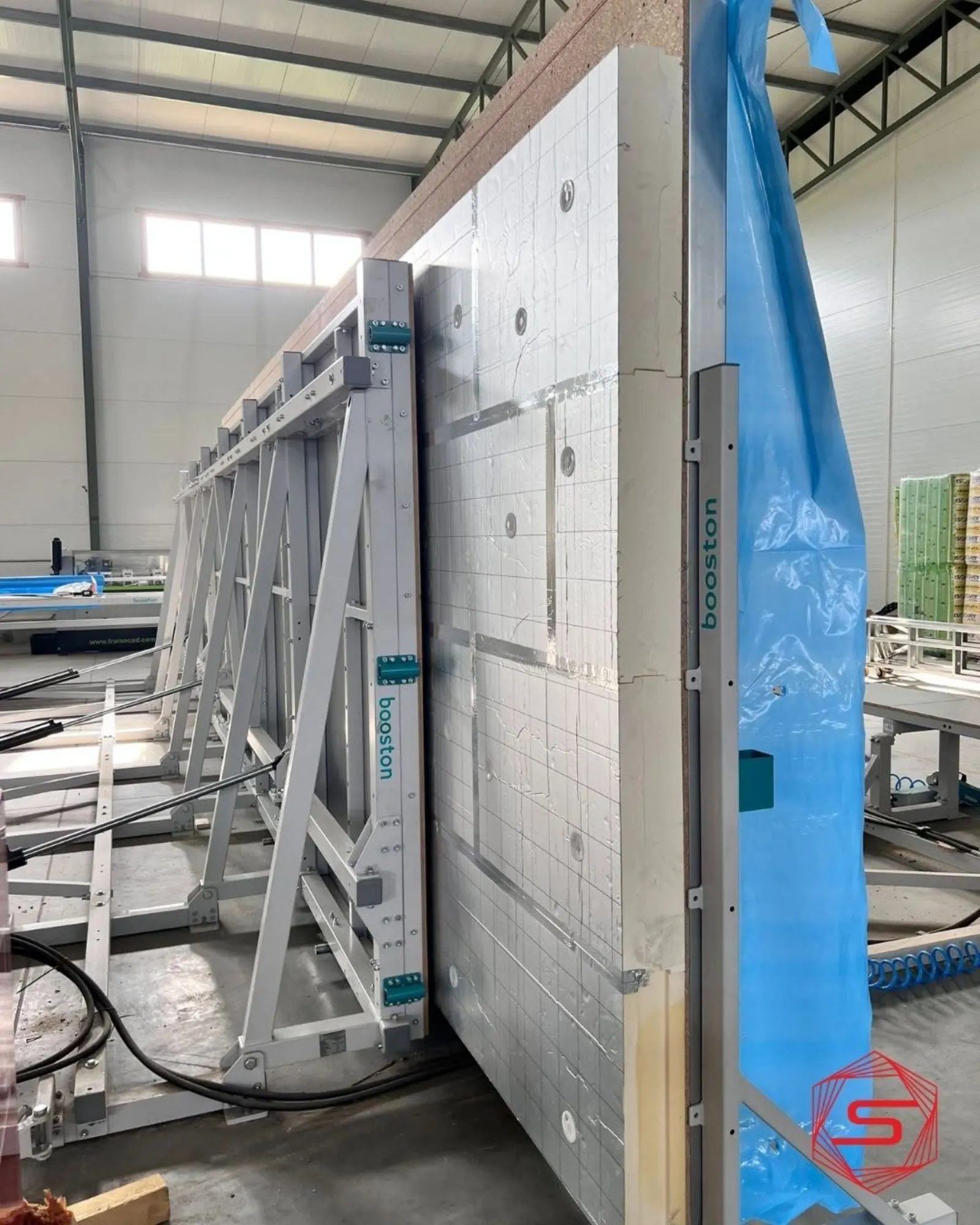
Overall performance depends on the complete wall, the small steel section and continuous insulation.
The argument systematically appears in comparisons: steel conducts heat better than wood, so a steel frame must be a poorer insulator. The argument is not physically false—the thermal conductivity coefficient of steel is indeed much higher than that of wood—but it is incomplete, because it ignores the variable that truly matters in a thermal bridge: the cross-section of material that actually passes through the insulation layer.
A thermal bridge is calculated as a flow of heat through a path of least resistance. What determines this flow is not only the material's conductivity but also the contact area and the length of the path the heat must travel. A light gauge steel stud presents only about 1 mm of material thickness in direct contact with the insulation, compared to 38 to 50 mm or more for an equivalent solid wood stud. The through-section is therefore, contrary to intuition, much smaller on the steel side.
Our framing systems also incorporate profiles with perforated or slotted webs, a technique that artificially lengthens the path heat must take through the metal, forcing the flow to bypass the perforations rather than crossing in a straight line. This geometry, combined with the small contact area, further reduces the point-source heat loss at each stud.
The regulatory calculation of a linear thermal bridge (standard EN ISO 10211) is expressed as a Psi coefficient, in W/(m·K), and it is this coefficient—not just the conductivity of the material in isolation—that must be compared between two construction systems to honestly judge their respective performance. Comparing two conductivities without considering geometry is like comparing two cars based on their engine displacement alone, without looking at their weight or aerodynamics.
Paired with a continuous layer of insulation placed on the correct side of the frame, without interruption at the studs, a light gauge steel wall achieves overall thermal performance that is comparable to, and in some configurations superior to, an equivalent wood-frame wall. The point of vigilance remains the same in both cases: the continuity of the insulation matters more than the material of the frame itself.
Steel also offers an advantage that wood cannot: complete dimensional stability over time, with no shrinkage, swelling, or deformation related to humidity. A wood stud that moves with ambient humidity can, over several years, open up micro-gaps at the junctions with insulation or windows—gaps that are invisible to the eye but that progressively degrade the wall's actual thermal performance, long after the project is completed.