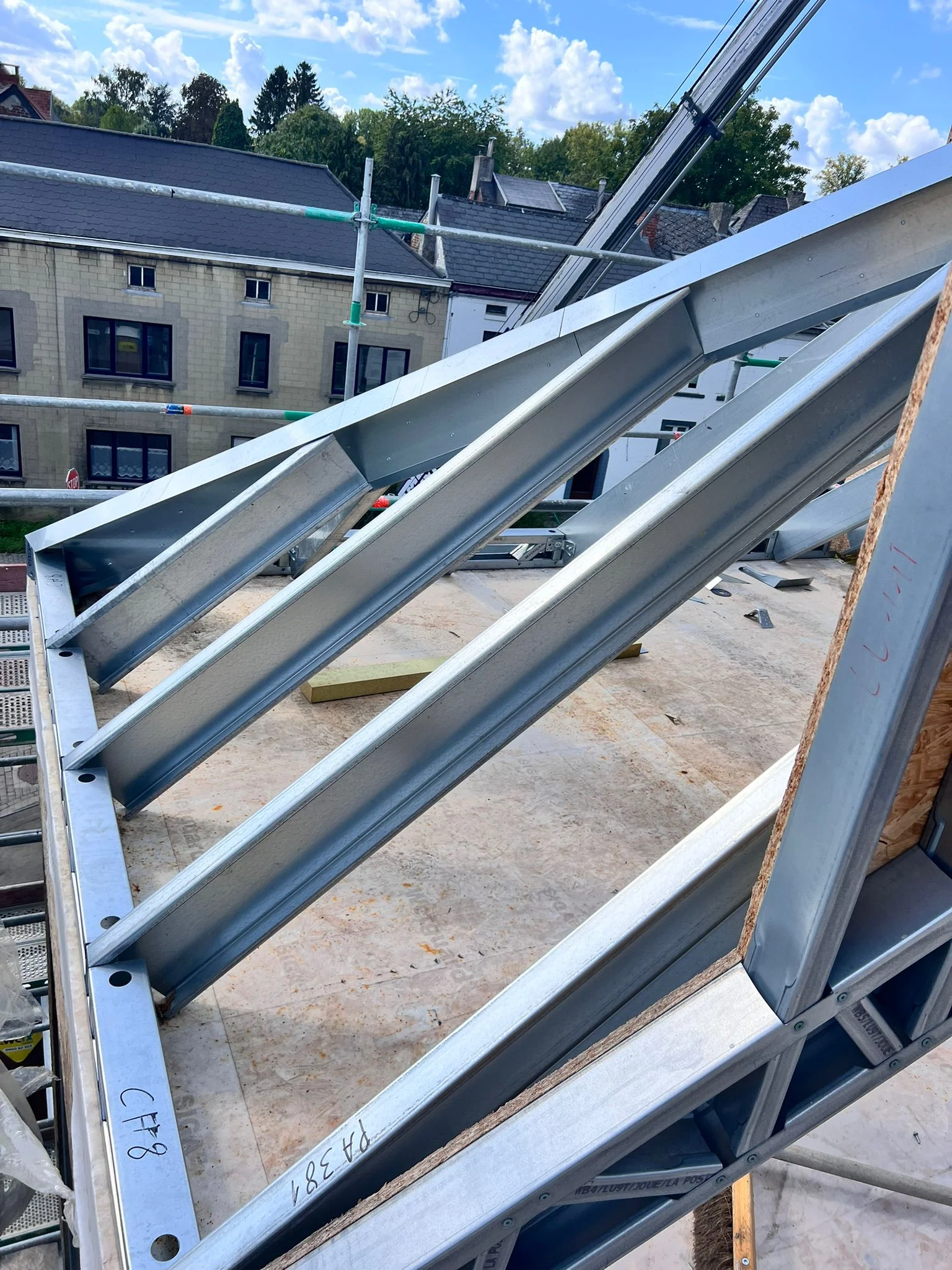
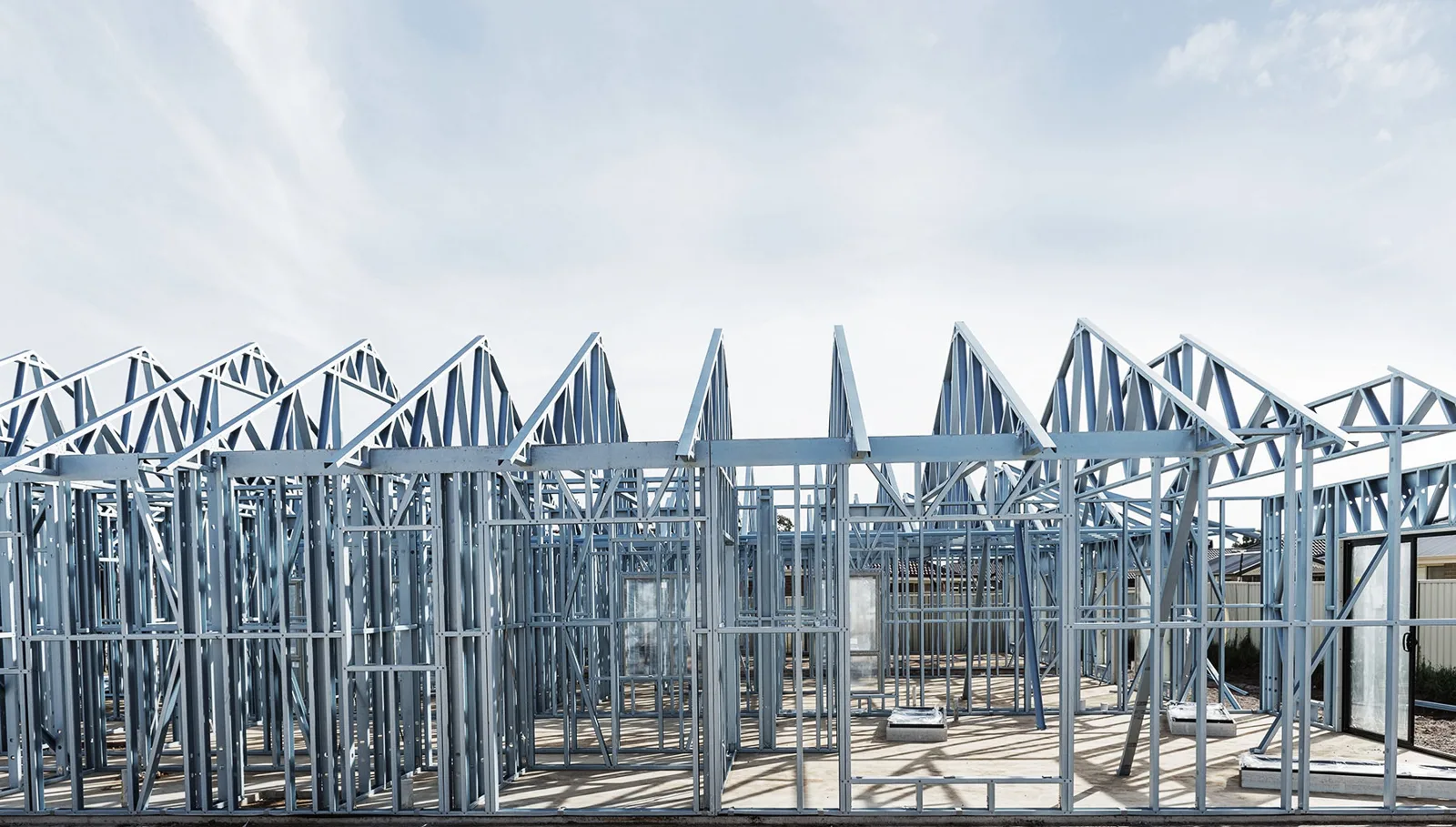
A much lighter structure reduces foundation loads and simplifies transport and handling.
A light gauge steel frame wall has a mass of 15 to 20 kg per square meter. An equivalent wall made of concrete blocks or bricks weighs between 150 and 250 kg per square meter, depending on the material and thickness. The difference is not a minor detail: it changes the very logic of construction. Masonry stands because it is heavy—a principle of mass and pure compression. A light gauge steel frame stands because it is well designed—a principle of form and working section.
Specifically, our profiles are cold-formed from steel sheet 1 to 3 mm thick, bent into C, U, or Sigma sections. This folding process transforms a simple sheet of metal into a rigid component capable of handling bending and compression forces without needing thickness or mass. It's the same principle that allows a sheet of paper folded like an accordion to support a book, whereas flat, it collapses: form replaces material.
We are often asked if this lightness comes at the cost of strength. The answer lies in calculation, not intuition: each section is engineered according to Eurocode 3, Part 1-3, which precisely governs the behavior of cold-formed thin-gauge profiles—local buckling, web crippling, and the punch-through resistance of openings. A properly stiffened and braced 1.5 mm profile is not a compromise; it is a component whose geometry has been optimized for its exact intended use, sized no more and no less than necessary.
This lightness is not just a technical curiosity; it has repercussions for the entire project. Foundations can be designed for significantly lower loads, which reduces the volume of concrete and earthwork required—a decisive advantage on soils with moderate bearing capacity, or when adding a story to an existing building whose foundations and load-bearing structure were not designed to support a heavy additional floor.
Weight also dictates the entire supply chain. A single truck can transport more usable structure for the same weight, reducing the number of trips needed for a project. On site, handling is done by hand: our panels each weigh less than 100 kg, allowing two or three people to position them without a heavy crane, even in difficult-to-access configurations where a crane simply could not maneuver.
It is this combination—a working section rather than mass, standardized calculation rather than intuition, leaner logistics, and manual installation—that explains why light gauge steel construction is not just “lighter” on paper: it truly changes how a project is prepared, engineered, delivered, and assembled, from the first line drawn by the design office to the last screw driven on site.