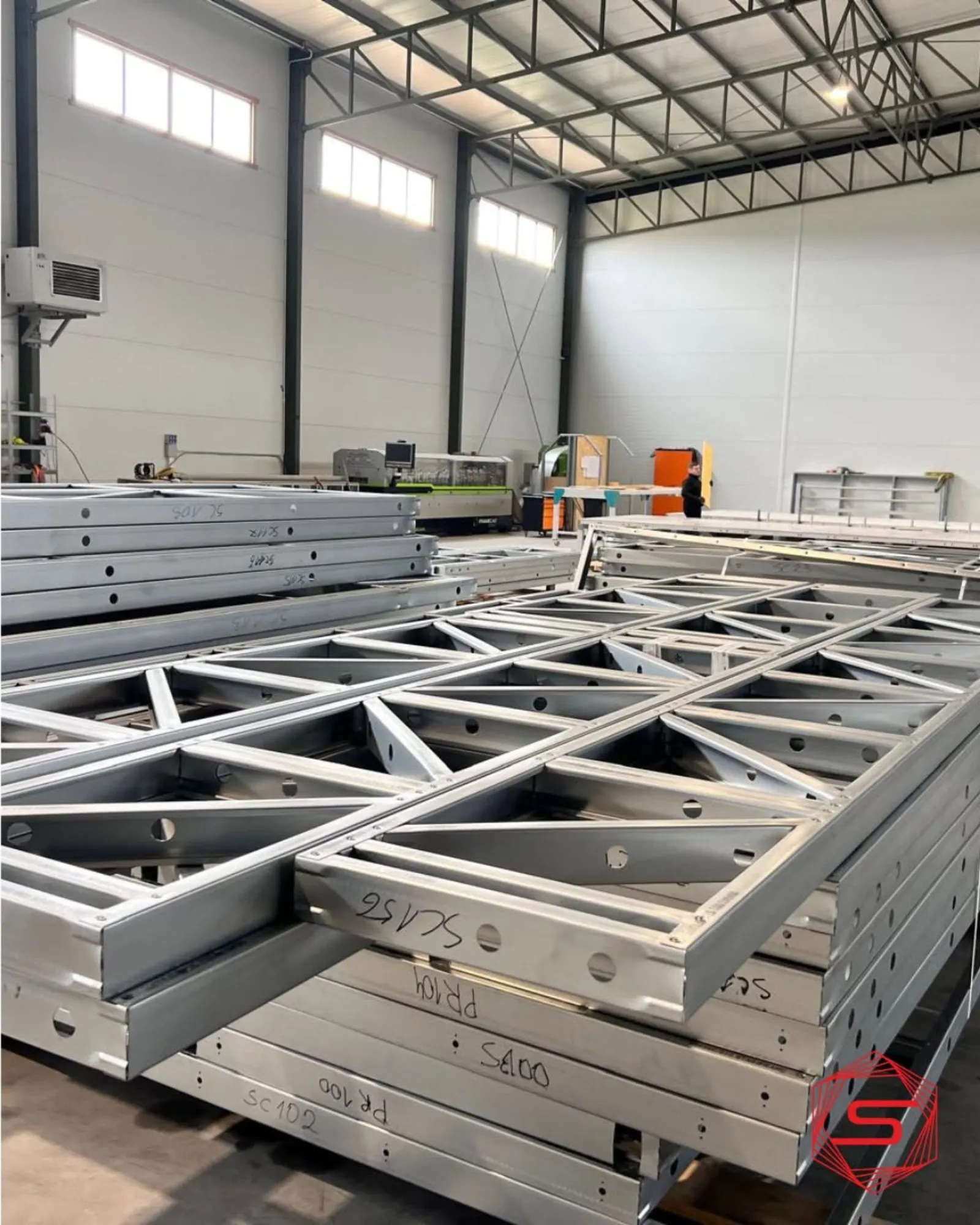
A high-performance lightweight floor combines resilient separation, suitable layers and absorbent insulation.
A concrete slab floor benefits from a natural acoustic advantage: the mass effect. The heavier a material is, the more inertia it offers to the passage of sound, for both airborne noise (voices, music) and impact noise (footsteps, shocks). A lightweight floor on steel joists does not have this mass at its disposal—which means acoustic performance must be achieved through system design, not by adding weight.
The technical solution relies on a different principle, that of the mass-spring-mass system. Instead of a single homogeneous mass, we superimpose several layers that are mechanically decoupled from one another, in order to break the transmission of vibrations at each interface rather than absorbing it through inertia. It's the same principle that explains why noise-canceling headphones work with decoupled layers rather than a single thickness of dense material.
In practical terms, our floor system combines three elements: a resilient decoupling layer between the load-bearing structure and the floor covering, which prevents vibration from being transmitted directly; a lightweight floor whose rigidity is engineered for the given span, to avoid perceptible vibrations when walked on; and a sub-floor plenum filled with absorbent insulation, which dissipates residual acoustic energy before it reaches the ceiling of the floor below.
This approach is measurable and standardized: sound reduction indices (Rw for airborne noise, Ln,w for impact noise) allow us to verify, right from the design stage, that a properly engineered lightweight floor achieves levels that meet, or even exceed, the current regulatory requirements for collective housing—for a mass per square meter several times lower than a solid concrete slab.
The most common mistake with this type of system is to try to compensate for poor decoupling by adding more insulation thickness. It doesn't work: a poorly decoupled lightweight floor will transmit impact vibrations regardless of the thickness of wool added in the plenum, just as a loudspeaker screwed directly to a table will continue to make that table vibrate even when surrounded by foam. It is the quality of the mechanical decoupling, not the quantity of insulation, that makes the difference.
The challenge for the design office, therefore, is not to choose between lightness and acoustic comfort; it is to design each layer of the system according to the building's actual use, the span of the joists, and the type of floor covering planned—a calculation that is done on a project-by-project basis, not from a catalog, and which directly determines the comfort perceived by occupants once the building is delivered.